


No one wants to pay more in taxes than is necessary, yet many insurance agency owners unfortunately do. Your taxes can be minimized by having your income trend evaluated by a CPA who can help determine the best entity (C-corp, S corp, LLC, Sole proprietorship) to help minimize your taxes.
If you are a Limited Liability Company (LLC), you need to elect how to be treated for tax purposes. The choices are: disregarded entity (treated as a sole proprietorship or partnership if more than one owner), S-corp, or C-corp. For purposes of this article, we will focus on S-corps, C-corps, and sole proprietorships.
In a sole proprietorship, all the agency’s revenues and expenses flow onto the Schedule C of the owner’s IRS Form 1040. The net profit is income to the owner and appears on the Schedule C.
With a C-corp, the agency owner receives a W-2 for their income, and any profit retained in the corporation will be taxed at 21% for federal purposes. However, when these profits are distributed to the owner (as dividends), the dividends are taxed to the individual receiving them, i.e., the owner. This results in double taxation. To avoid this, most C-corp owners distribute any profits from the corporation. This bonus will be included on the W-2.
S-corporations (S-Corps) function a bit differently. S-corps do not pay taxes. The shareholder/owner is paid a salary, which is documented on a W-2. Any profit in the S-corp appears on a Schedule K-1, which the shareholder records on their Form 1040. Whether the income shows up on a W-2 or a K-1, it is subject to federal income tax.
The big difference is FICA. Most people think that FICA is 7.65%. In reality, it is 6.2% for Social Security and 1.45% for Medicare. Remember that both the employer and the employee pay these amounts. So an agency owner is really paying 12.4% for Social Security and 2.9% for Medicare. However, while Social Security is capped ($184,500 for 2026), there is no cap on Medicare payments.
Assume you have $300,000 in income in 2026. As a C-corp, you will need to take it all on your W-2 to avoid double taxation, and you will pay $45,900 between social security and Medicare. Since the IRS recognizes Schedule C income no differently than W-2 income, it will also pay $45,000 in FICA taxes.
However, K-1 income is not subject to FICA taxes, resulting in a savings of $5,800 in Medicare taxes for the agency owner (by taking a 100k salary and taking the 200k as dividends). For every $100,000 of income that is taken as profits, an S-corp agency owner can save $15,300 in taxes. In this case, the savings would be $30,600.
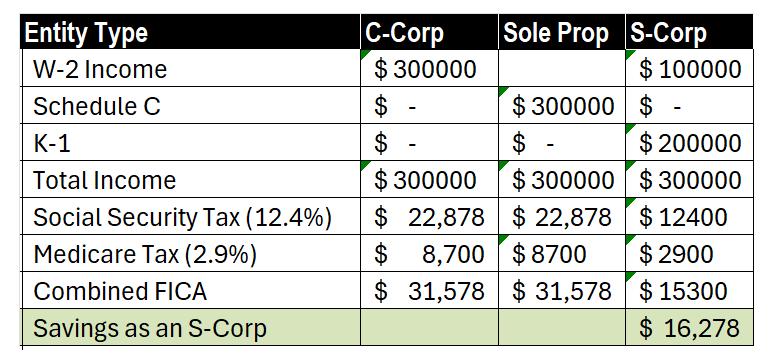
So why shouldn’t an S-Corp agency owner take a salary significantly lower than $100,000, or even all of his income on his K-1 and totally avoid FICA taxes? There are several reasons:
IRS requires a person to take a reasonable amount of income on his W-2.
The less you pay in social security taxes, the less you will receive when it comes time to collect. The issues of salary vs. K-1 and the type of entity you are should be discussed with your CPA BEFORE the end of the year.
