

By: AgencyEquity.com
The history of insurance agencies in the United States is not simply a story of financial products, but of distribution—of how insurance moved from abstract contracts to a relationship-driven business embedded in communities. While insurance itself has ancient roots, the American insurance agency system developed much later, shaped by geography, economic expansion, and a uniquely decentralized business culture.
Early Foundations: Local Representation in a Growing Nation
In the late 18th and early 19th centuries, as the United States expanded beyond its coastal cities, insurance companies faced a fundamental challenge: distance. Most insurers were based in urban centers like Philadelphia, New York, and Boston, but their potential customers—farmers, merchants, and property owners—were scattered across a vast and growing nation.
To bridge this gap, insurers began appointing local representatives. These early agents were not “agencies” in the modern sense, but rather trusted individuals—often merchants, bankers, or lawyers—authorized to solicit applications, collect premiums, and sometimes assess risk. Their role was as much about reputation as it was about sales. In small towns, trust was the currency that made insurance viable.
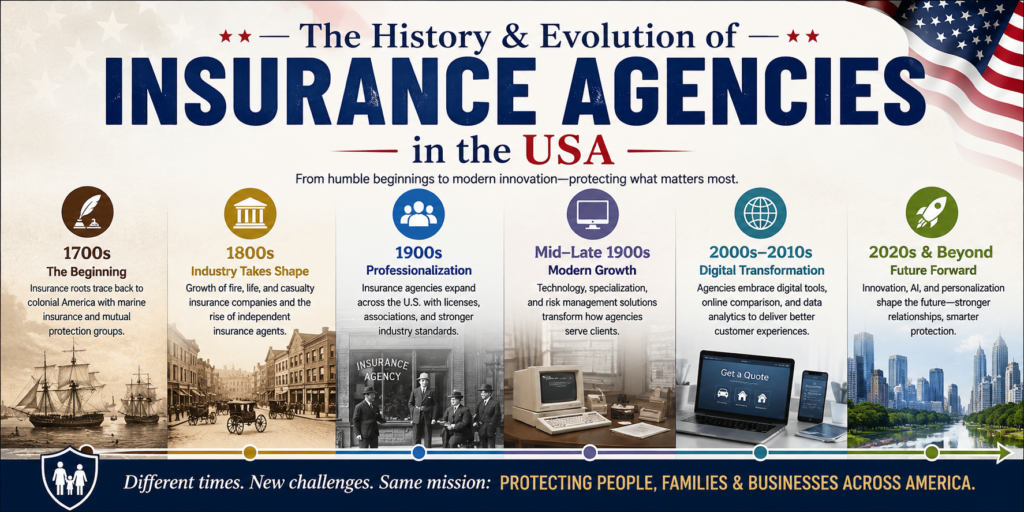
Over time, these representatives became more formalized. By the mid-1800s, the idea of a dedicated insurance agent—someone whose primary business was placing coverage—was becoming more common. Still, most agents worked exclusively for a single company, reflecting the dominant “captive agent” model of the era.
The 19th Century: Expansion, Independence, and the Birth of Agencies
The 19th century was the defining period for the emergence of true insurance agencies in America. As railroads spread, cities grew, and commerce intensified, the demand for insurance surged—particularly for fire and marine risks.
This expansion created an opportunity for a new kind of intermediary: the independent agent. Unlike captive agents, independent agents represented multiple insurance companies, allowing them to offer clients a range of options. This model proved especially valuable in a competitive and fragmented market, where no single insurer could meet every need.
By the late 1800s, independent agencies were becoming established businesses in their own right. They were no longer just extensions of insurers, but professional service firms that advised clients, negotiated coverage, and built long-term relationships. Many of these agencies were family-run and deeply rooted in their communities, a characteristic that would define the industry for generations.
Industry organizations also began to form, helping standardize practices and advocate for agents’ interests. These developments marked the transition from informal representation to a structured distribution system.
Early 20th Century: Professionalization and Identity
The early 20th century saw insurance agencies solidify their identity as a distinct profession. Licensing requirements, ethical standards, and regulatory frameworks began to take shape at the state level, formalizing who could act as an agent and how they could operate.
During this period, agencies expanded their role beyond simple policy placement. They became advisors—helping businesses manage risk, structuring coverage portfolios, and assisting with claims. The relationship between agent and client grew more consultative, laying the groundwork for the modern brokerage model.
At the same time, the distinction between “agents” and “brokers” became more pronounced. While terminology varied by state, agents were typically seen as representatives of insurers, while brokers were understood to represent the client. In practice, many agencies operated somewhere in between, balancing relationships with carriers and clients alike.
Mid-20th Century: Growth, Stability, and the Community Agency
Following World War II, the United States entered a period of economic expansion that fueled massive growth in the insurance industry. Homeownership increased, automobiles became ubiquitous, and businesses scaled rapidly. Insurance agencies were at the center of this growth.
The mid-20th century is often considered the golden age of the local insurance agency. Independent agencies, in particular, thrived by offering personalized service and access to multiple carriers. They became fixtures in towns and cities across America—often recognizable storefronts where clients could walk in, speak directly with an agent, and receive tailored advice.
During this time, many agencies expanded into multiple lines of business, including personal insurance, commercial coverage, and employee benefits. They also began to develop internal specialization, with staff focusing on underwriting, claims support, or client service.
The agency system itself became the dominant method of insurance distribution in the United States, distinguishing it from other countries where direct or government-run systems played a larger role.
Late 20th Century: Consolidation and Corporate Influence
By the 1970s and 1980s, the insurance agency landscape began to shift. Economic pressures, regulatory changes, and increased competition led to consolidation within the industry. Larger agencies and brokerage firms began acquiring smaller, independent shops, creating regional and national players.
At the same time, major insurers strengthened their captive agent networks, investing in branding and training to create more uniform customer experiences. Companies like State Farm and Allstate built extensive agency systems that blended local presence with corporate infrastructure.
Technology also started to reshape agency operations. Computerized systems replaced paper files, improving efficiency in policy management and communication with carriers. While the core relationship-based model remained intact, the tools of the trade were evolving rapidly.
The 21st Century: Digital Disruption and Reinvention
The rise of the internet introduced one of the most significant challenges in the history of insurance agencies: disintermediation. Direct-to-consumer insurers and online comparison platforms allowed customers to bypass agents entirely, at least for simpler products like auto and renters insurance.
For a time, it seemed possible that traditional agencies might decline. Instead, they adapted.
Modern insurance agencies have redefined their value proposition. Rather than competing solely on price or convenience, they emphasize expertise, customization, and advocacy. For complex risks—commercial insurance, high-net-worth personal coverage, cyber liability—clients increasingly rely on agencies to navigate a crowded and technical marketplace.
Digital tools have also been integrated into agency operations. Customer relationship management systems, data analytics, and online service platforms enable agencies to operate more efficiently while maintaining a personal touch.
At the same time, consolidation has accelerated, with private equity and large brokerage firms acquiring independent agencies at an unprecedented pace. Yet even within this trend, the local agency model persists—often rebranded, but still rooted in relationships.
Conclusion: A Distinctly American Model
The history of insurance agencies in the United States is a story of adaptation to scale, distance, and complexity. From lone representatives in frontier towns to sophisticated firms advising multinational clients, agencies have continuously evolved to meet the needs of a changing economy.
What makes the American system distinctive is its enduring reliance on intermediaries. Even in an age of automation and direct access, the agency model remains resilient because it solves a fundamental problem: translating complex risk into understandable, actionable decisions.
In that sense, while the tools and structures have changed, the core function of the insurance agency—serving as a trusted guide between client and insurer—has remained remarkably consistent for over two centuries.
