


One of the most important responsibilities of a commercial insurance agency is helping business owners identify and protect against the risks that could threaten their companies. While insurance professionals cannot force a client to purchase every recommended coverage, they do have a duty to provide sound advice, explain significant exposures, and ensure clients understand the consequences of declining important protections. Those issues were at the center of Williams v. Hilb, Rogal & Hobbs Insurance Services of California, Inc., a California Court of Appeal case that continues to offer valuable lessons for insurance agencies today.
The case began in 1999 when John Williams and Steven Simon opened a Rhino Linings dealership in Santa Fe Springs, California. Because neither owner had prior experience operating this type of business, they relied heavily on insurance agent Robyn Thaw, who held herself out as having specialized expertise in the insurance needs of Rhino Linings dealerships. She had helped develop insurance programs specifically for these businesses and even spoke at dealership seminars about their insurance requirements. Naturally, the business owners believed they were working with someone who understood exactly what coverages their operation needed.
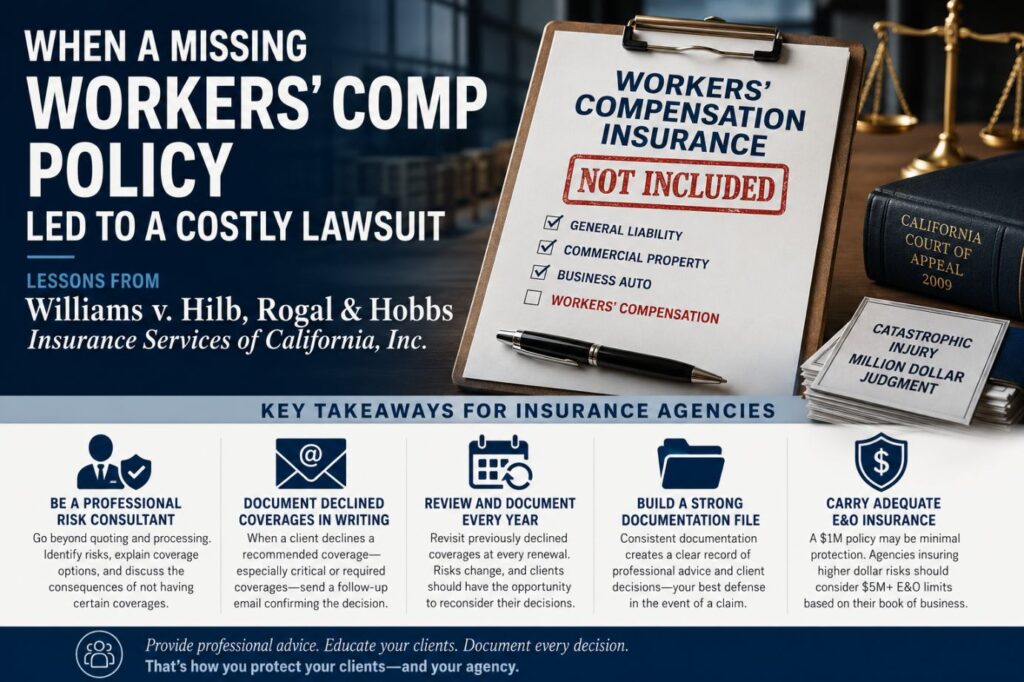
Thaw presented what appeared to be a comprehensive commercial insurance package that included commercial general liability insurance and several other coverages tailored to the dealership. The owners accepted the proposal, believing they had obtained the insurance necessary to operate their business safely and legally.
Unfortunately, one critical policy was missing—workers’ compensation insurance.
California law requires employers to maintain workers’ compensation coverage for their employees. Despite this legal requirement, the insurance package did not include workers’ compensation insurance. The business owners later testified they were never told that the coverage had been omitted or that they needed to purchase it separately. The agency disputed that claim, asserting the coverage had been discussed and declined, but there was no written documentation clearly confirming that conversation or the insureds’ decision.
The omission remained unnoticed for nearly three years.
Then tragedy struck.
An employee suffered catastrophic injuries in a fire while working with the spray-on truck bed lining materials used by the business. When the owners attempted to submit the claim, they discovered they had no workers’ compensation insurance. The injured employee ultimately obtained a multimillion-dollar judgment against the business owners. Faced with devastating financial exposure, the owners filed suit against their insurance agency, alleging it had failed to properly advise them and procure the coverage their business required.
After a bench trial, the court ruled in favor of the business owners.
The court concluded that the insurance agent had assumed responsibilities beyond simply processing insurance applications. By marketing herself as an expert in the insurance needs of Rhino Linings dealerships and by creating specialized insurance programs for those businesses, she assumed a heightened duty to exercise the level of skill and care expected of a reasonably prudent insurance professional under similar circumstances. The court determined she failed to meet that standard by not ensuring the owners understood that workers’ compensation insurance was both legally required and absent from the insurance package.
The agency argued that the owners should have discovered the omission by reading their insurance policies. The Court of Appeal rejected that argument. While policyholders are generally encouraged to review their policies, the court recognized that insureds often place substantial trust in experienced insurance professionals—particularly when those professionals market themselves as specialists in a particular industry. The Court of Appeal affirmed the judgment against the insurance agency.
Lessons for Insurance Agencies
The most important lesson from Williams v. Hilb, Rogal & Hobbs Insurance Services of California, Inc. is that insurance agencies should strive to be professional risk consultants—not merely order takers.
Business owners rely on insurance professionals because they generally do not possess the same level of knowledge regarding commercial insurance exposures. An agency’s responsibility should be to identify potential risks, explain available coverage options, discuss the consequences of going without certain coverages, and help clients make informed decisions. While the final purchasing decision always belongs to the client, that decision should be based on a full understanding of the risks involved—not simply on price or convenience.
Equally important is documenting those discussions. Whenever a client declines a recommended coverage—particularly one that is legally required, commonly purchased, or designed to protect against catastrophic losses—the agency should promptly send a follow-up email or letter confirming the recommendation, explaining the exposure, and documenting the client’s decision to decline the coverage. That documentation should become part of the agency’s permanent file.
These conversations should also occur every year at renewal. Businesses change over time. Payroll increases, operations expand, new equipment is purchased, additional employees are hired, and new risks emerge. An annual coverage review gives clients the opportunity to reconsider previously declined coverages while giving the agency another opportunity to provide professional advice. If the client again declines the recommendation, the agency should once again document the decision in writing. This annual process not only improves client service, but also creates a valuable record demonstrating that the agency consistently fulfilled its professional responsibilities.
Finally, this case underscores the importance of carrying adequate Errors & Omissions insurance. Many agencies continue to carry $1 million E&O policies, but for agencies serving commercial clients, that may represent only minimal protection. A single claim involving a serious workplace injury, a large commercial property, or a significant liability exposure can quickly exceed a $1 million policy limit. Agencies that insure larger commercial risks should strongly consider discussing $5 million or higher E&O limits with their own E&O carrier or advisor to determine whether their current coverage adequately reflects the size and complexity of their book of business.
Ultimately, the best defense against an E&O claim is not simply purchasing insurance—it is practicing as a trusted insurance consultant. Agencies that proactively identify exposures, educate clients, revisit coverage decisions every year, and thoroughly document recommendations and declinations provide a higher level of professional service while significantly reducing the likelihood of costly litigation. In today’s increasingly complex insurance environment, those practices are not just good risk management—they are the hallmark of a truly professional insurance agency.
