


For independent insurance agencies, the past four years have been among the most challenging market cycles in recent memory. Rising claim severity, inflation, catastrophic weather losses, higher reinsurance costs and regulatory pressures pushed many preferred carriers to restrict new business, tighten underwriting guidelines and reduce appetite in difficult geographies. For a startup agency, gaining meaningful carrier access could be especially difficult.
As we move through 2026, however, there are increasingly clear signs that conditions are improving. The marketplace is not uniformly “soft,” and difficult areas remain, but the environment for starting and growing an independent agency is arguably better today than at any point in the past several years.
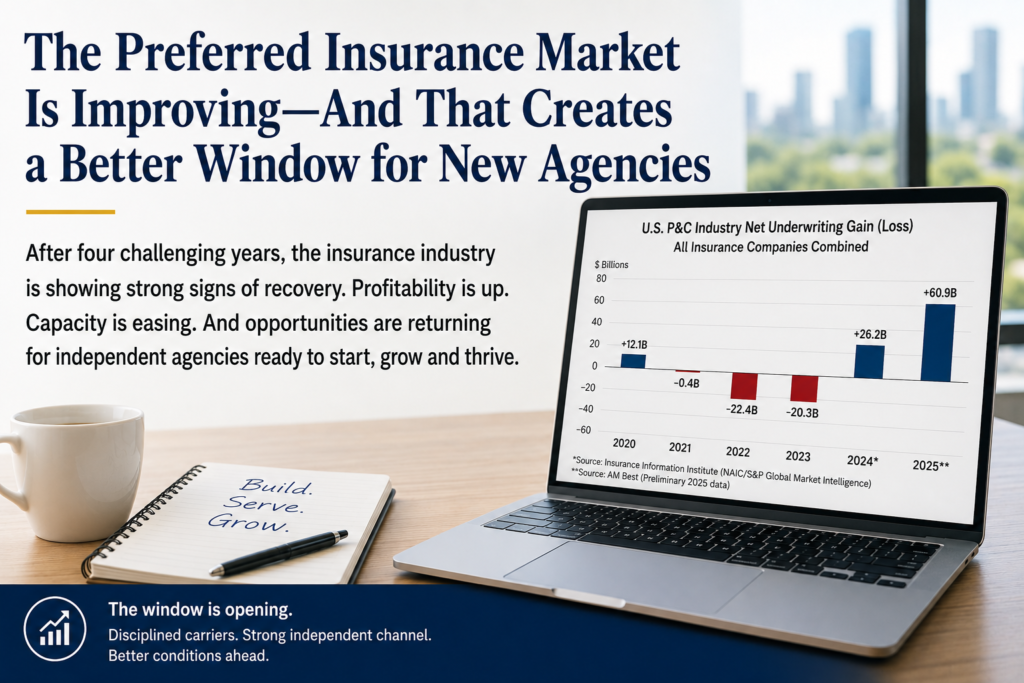
The strongest evidence comes from carrier profitability. AM Best reported that the U.S. property and casualty industry generated approximately $60.9 billion in net underwriting income during 2025, nearly three times the $22.1 billion recorded in 2024. The industry combined ratio improved to approximately 92–93, representing its strongest underwriting performance in roughly a decade.
That matters to agencies because profitable carriers generally have greater flexibility to pursue growth. When carriers are losing money, the response is predictable: higher rates, reduced capacity, restrictive underwriting and fewer new appointments. When profitability returns, the conversation gradually shifts from protecting the existing book toward intelligently acquiring new business.
Personal auto provides perhaps the clearest example. Triple-I (Insurance Information Institute) reports that the personal auto combined ratio improved to 91.8 in 2025, following years of post-pandemic volatility. Homeowners insurance is also showing early signs of stabilization, with Triple-I projecting broader profitability in the segment during 2026.
For independent agencies, another encouraging indicator is that the distribution channel itself remains remarkably strong. According to the Big “I” 2026 Market Share Report, independent agencies placed 62% of all U.S. P&C premiums in 2025, including approximately 87.7% of commercial-lines premiums. Independent agency market share actually increased slightly from 2024.
Carrier-agent relationships also appear to be improving. First Connect’s 2026 industry survey found that agent-reported problems declined across every carrier partnership metric measured. Challenges surrounding quote speed fell by roughly 50% year over year, while problems understanding carrier appetite declined 53%. That represents an important shift for producers who spent much of the hard market struggling simply to determine where business could be placed.
New agencies still face the classic carrier questions: How much premium can you produce? What is your prior experience? What is your business plan? What markets will you target? How will you control loss ratios, retention and growth? Preferred carriers are unlikely to abandon disciplined underwriting simply because profitability has improved. Being a part of an Agency Network can help an agency deal with some of the obstacles.
Agency networks, aggregators, alliances and technology-enabled market-access platforms can provide paths to carriers that might otherwise require years of production before offering a direct appointment. Faster quoting technology, digital servicing and more efficient agency management systems also allow a small operation to handle a substantially larger book of business than was historically practical. You can view a list of these groups on AgencyEquity’s Network Directory.
The opportunity should still be viewed geographically and by line of business. Catastrophe-exposed homeowners markets remain difficult, and commercial auto and general liability continue to present profitability challenges. Triple-I expects those liability-oriented lines to gradually improve.
The Broader Direction is Encouraging
The 2022–2024 marketplace was largely about restriction, remediation and survival. The developing 2026 marketplace is increasingly about disciplined growth.
For an experienced insurance professional considering launching an independent agency, that difference is significant. Preferred carrier access will still need to be earned, but improving carrier profitability, stabilizing personal lines, stronger technology, expanding market-access alternatives and the continued strength of the independent agency channel collectively create a more favorable startup environment than existed during much of the previous four years.