


For several years, insurance agencies faced a problem they could not control: admitted insurance carriers stopped writing large segments of business. Carriers tightened underwriting requirements, reduced capacity, restricted geographic areas and, in some cases, withdrew from entire classes of business. Agencies that previously had numerous admitted-market options suddenly found themselves with few—or none.
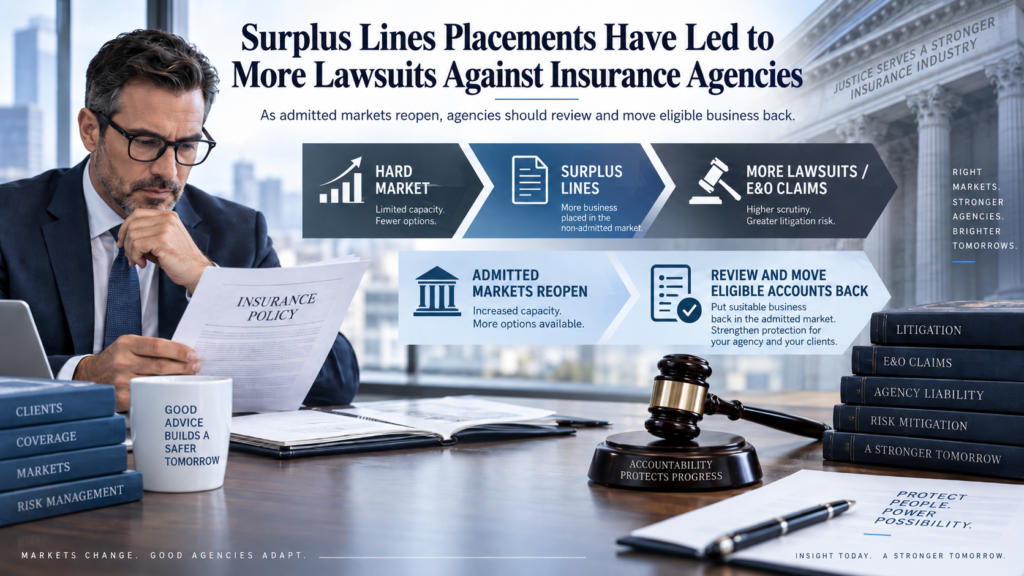
The excess and surplus lines market became the solution. Surplus lines insurance serves an extremely important purpose when a risk cannot be placed with an admitted carrier. It provides insurance agencies with markets for difficult, unusual or catastrophe-exposed risks that standard carriers are unwilling to accept.
However, when coverage is available in the admitted market, admitted carriers more often than not can offer advantages, including broader or more familiar policy forms, fewer restrictive provisions and often lower rates. Admitted policies also operate under a different regulatory structure and may provide protections that are unavailable with non-admitted policies.
The massive movement of business into surplus lines during the hard market has consequently created another problem for insurance agencies: increased E&O exposure and lawsuits involving coverage placed in the surplus-lines market.
Hard Markets Created More E&O Exposure
Agency E&O claims have increased in both frequency and severity in recent years, with industry risk-management experts identifying the hard market and increased movement into excess and surplus lines as contributing factors.
The reason is relatively simple. Surplus-lines policies frequently contain different exclusions, deductibles, coverage limitations, conditions and policy language than the admitted-market policies agents and their customers previously purchased.
During the hardest portions of the market, an agent might have had little choice. If the admitted carriers would not write the account, an E&S placement was substantially better than leaving the customer uninsured.
But problems can develop when a loss occurs and the customer discovers that the policy does not provide coverage in the manner the customer expected.
E&S Markets Means More Lawsuits
Recent litigation demonstrates the problem. In one lawsuit involving an HVAC contractor, the insured sued its insurance agency after replacement liability coverage was obtained following termination of its previous insurance. Among the allegations was that the replacement coverage was supposed to be written through an admitted carrier rather than the surplus-lines market.
The insurance agency ultimately prevailed on summary judgment, but that does not mean the agency escaped without consequences. It still had to defend itself against litigation.
Another dispute involving a California insurance agency included allegations that policies had been placed through non-admitted insurers when comparable coverage allegedly could have been obtained through admitted carriers. Questions arose regarding whether the agency had adequately searched the admitted market before making the surplus-lines placements.
These cases illustrate an important lesson. An insurance agency does not necessarily have to lose a lawsuit for the lawsuit itself to become expensive. Even if agency wins. defense costs, employee time, attorney fees, E&O deductibles and the disruption caused by litigation can all become substantial.
Solving the Problem: A Changing Market is Opening up Doors to Admitted Markets
The good news for insurance agencies is that conditions are beginning to move in the opposite direction.
After years of rapidly increasing premiums and shrinking capacity, more doors are being opened. Property insurance pricing has begun declining in some segments, insurers are competing for desirable accounts, reinsurance conditions have improved and carriers are expanding underwriting appetites.
That means some accounts that agencies were forced to place into surplus lines during the hard market may once again qualify for admitted coverage. Insurance agencies should pay close attention to this change.
Don’t Leave Accounts in Surplus Lines by Default
Agencies should identify accounts that were placed into surplus lines because admitted coverage was unavailable and systematically review those accounts as admitted carriers reopen their underwriting appetites. Every attempt should be made to move a surplus lines policy into the admitted markets, provided the coverage is superior and all coverages of a given policy are available.
Certain risks legitimately belong in the E&S market, and there will be situations where the surplus-lines policy provides better terms or is still the only practical option. But an account should not remain in surplus lines simply because nobody has bothered to remarket it.
When admitted carriers begin accepting a class of business again, agencies should compare the available options. Look at the premium, coverage forms, exclusions, deductibles, limits, restrictions and financial strength of the carriers.
There is also an important customer-retention consideration. If an agency leaves a client with an expensive or restrictive surplus-lines policy while another agency discovers that the account can now be moved back into an admitted market at a better price or with better coverage, the incumbent agency risks losing the account.
The hard market required insurance agencies to become exceptionally resourceful at finding alternative markets for their customers. As admitted markets reopen, agencies now need to be equally aggressive about moving appropriate accounts back.
Doing so isn’t simply about obtaining better pricing. It can provide customers with better coverage options, strengthen client relationships—and potentially reduce the agency’s exposure to the next surplus-lines-related lawsuit.
